
Buying Terms Made Simple: FOB Colombo, CIF, and CFR for Tea Importers
Every Tuesday morning in Sri Lanka, the trading floor of the historic Colombo Tea Auction comes alive. Buyers, brokers, and exporters sit side by side, calling out quick bids for thousands of unique factory lots. Millions of kilograms of fresh leaf pass through these trading halls every week. But once the auction hammer falls, another critical process begins: moving that pristine tea out of high-country factories, through port gates, and across open oceans to your warehouse door.
For overseas brand owners, wholesale importers, and beverage buyers, buying tea across international borders can sometimes feel confusing. You might see price quotes marked as FOB Colombo, CIF Hamburg, or CFR Dubai, and wonder what those three-letter codes actually mean for your final bottom line.
In simple terms, international shipping rules—known globally as Incoterms—define who pays for shipping, who handles port paperwork, and who bears the risk if something goes wrong at sea. Understanding these terms helps you protect your profit margins and avoid costly surprises at the port.
Here is a clear, straightforward breakdown of how Ceylon Tea travels from island estates to global markets, and how to choose the right buying terms for your business.
1. How Ceylon Tea Travels from Sri Lanka to the World
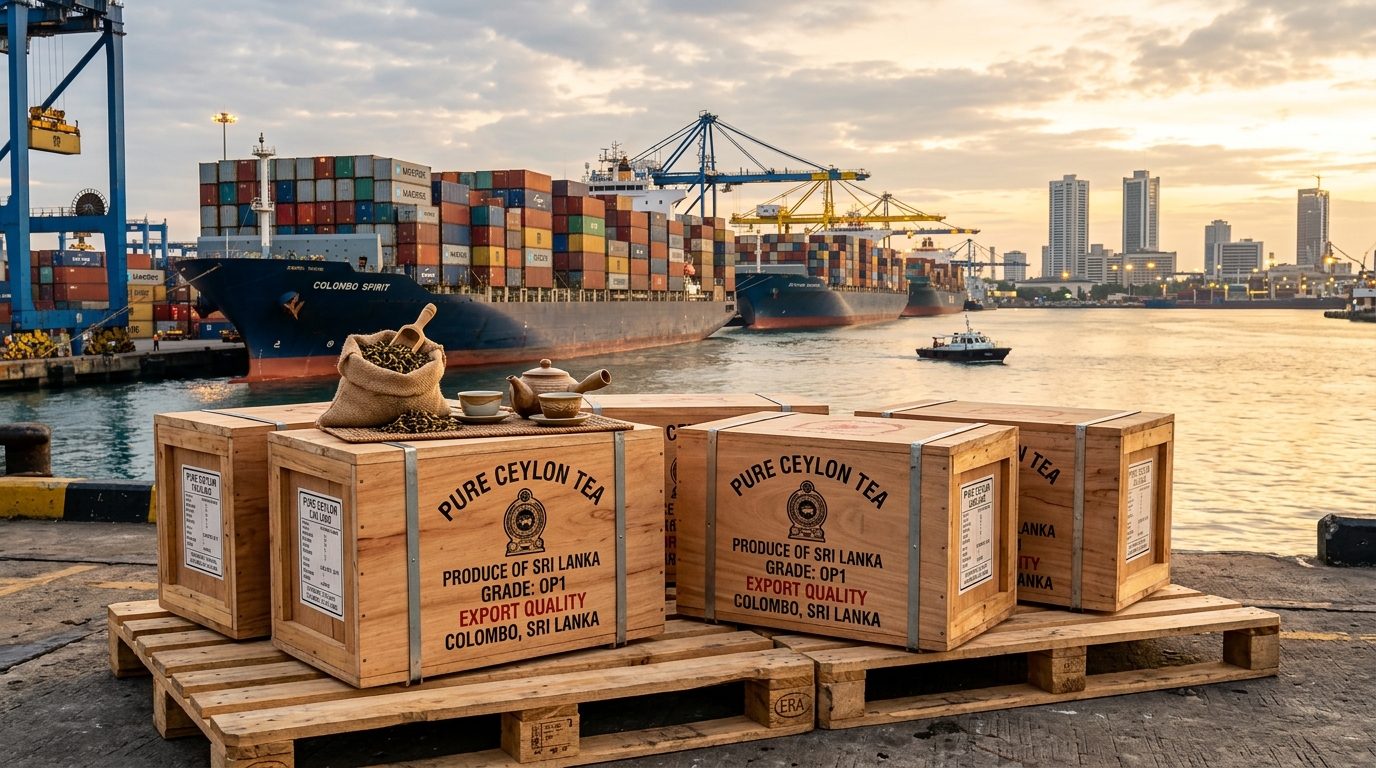
Sri Lanka occupies a prime spot in the middle of major Indian Ocean shipping lanes. Because of this strategic location, the Port of Colombo serves as one of the busiest and most efficient container shipping hubs in South Asia. Fresh tea leaves picked in cloud-wrapped mountain gardens can be processed, packaged, transported to the port, and loaded onto ocean freight vessels in just a few short weeks.
Global demand for pure Ceylon tea spans over 140 countries. Massive market hubs across the Middle East, Europe, North America, the CIS region, and East Asia rely on daily container departures from Colombo. Whether you are sourcing full container loads of broken leaf grades for commercial tea bags or high-grade whole leaf teas for loose-leaf tins, ocean shipping remains the primary lifeline connecting producers to buyers.
To keep these trade channels running smoothly, international buyers purchase tea through structured supply pathways. You can source tea directly through registered Sri Lankan exporters, engage dedicated buying agents, or procure lots won at the weekly public auction. Whichever path you choose, establishing clear delivery agreements early in your trade negotiations ensures your tea arrives on time and within budget.
To explore direct trade connections and commercial supply routes, you can browse our directory of registered tea exporters or learn more about bulk tea suppliers.
2. Inside the Historic Colombo Tea Auction
To understand shipping terms, it helps to see where export prices begin. Operating continuously since 1883, the Colombo Tea Auction is the oldest and largest single-origin tea auction in the world. Every week, hundreds of tea factories send fresh production samples to independent brokerage firms located in Colombo.
Before any trading begins, expert tea tasters evaluate every single lot. They test for leaf appearance, liquor color, briskness, and sensory characteristics. These lot details are published in weekly auction catalogs distributed across the trade network.
COLOMBO TEA AUCTION TRADE FLOW
Exporters bid on specific lots to fulfill contracts for their international clients. Once an exporter wins a lot at auction, the tea is moved from regional factory stores to specialized logistics facilities in and around Colombo. Here, the raw auction lots are inspected, cleared through official laboratory safety panels, packed into export-ready containers, and scheduled for vessel loading.
You can monitor current market trends and lot pricing through our live Colombo auction prices tracker.
3. Essential Export Rules, Permits & Quality Guarantees
Sri Lanka maintains strict legal controls over its tea exports to safeguard quality and origin authenticity. Before any tea container can leave the Port of Colombo, the cargo must pass thorough state inspections and clear mandatory trade documentation.
The Sri Lanka Tea Board acts as the official government watchdog. It ensures that outgoing tea meets international safety limits, retains genuine origin purity, and complies with official standards like ISO 3720 quality guidelines.
Colombo Export Step-by-Step Quality Checklist
These regulatory safeguards ensure that international buyers receive authentic products that comply with strict foreign import rules, including EU and FDA maximum residue limits. Additionally, qualifying shipments earn the right to display the trademarked Pure Ceylon Tea Lion Logo, proving the tea was grown, processed, and packed entirely in Sri Lanka.
The following table breaks down the main documents required for exporting tea from Sri Lanka:
| Export Step or Document | Who Issues It | Why It Matters for Buyers | How Long It Takes |
|---|---|---|---|
| Tea Board Export Clearance | Sri Lanka Tea Board | Confirms physical quality, purity, and grade compliance | 1 to 2 Working Days |
| Phytosanitary Certificate | Department of Agriculture | Proves leaves are free from agricultural pests and plant diseases | 1 to 2 Working Days |
| Certificate of Origin | Ceylon Chamber of Commerce | Verifies genuine Sri Lankan origin for preferential tariff rates | 1 Working Day |
| Laboratory Analysis Report | Certified Testing Labs | Tests pesticide residue levels and chemical safety standards | 3 to 5 Working Days |
| Ocean Bill of Lading (B/L) | Shipping Line / Carrier | Acts as legal title of ownership for customs pickup at destination | 1 to 2 Days After Sailing |
4. Packing and Shipping Tea: Keeping Leaves Fresh Across the Ocean
Tea is an absorbent, sensitive agricultural product. Dry leaf matter quickly absorbs surrounding moisture, odors, and foreign flavors if left exposed to ambient air. Ocean transit requires precise packaging techniques to ensure tea leaves arrive in fresh condition.
Commercial bulk tea is typically packed in multi-wall paper sacks lined with continuous aluminum foil or food-grade polyethylene barriers. These heavy-duty sacks prevent ambient sea humidity from seeping into the dry leaf during tropical voyages. For retail-ready shipments, finished goods are sealed in foil pouches, tin canisters, or consumer packs and pyramid tea bags inside sturdy outer cartons.
When booking ocean transport, tea exporters choose between two primary container shipping methods:
- FCL (Full Container Load): An entire 20-foot or 40-foot shipping container is reserved exclusively for your shipment. A standard 20-foot container holds roughly 10,000 to 11,000 kilograms of bulk black tea in paper sacks, or up to 20,000 kilograms of densely compressed CTC teas. FCL shipping offers lower risk of damage, zero risk of cross-odor contamination from other goods, and faster port handling.
- LCL (Less than Container Load): If you are ordering smaller quantities (such as 1,000 to 3,000 kilograms), your shipment shares container space with other compatible cargo. While LCL reduces shipping costs for smaller orders, your exporter must ensure nearby goods emit no chemical or aromatic odors that could ruin the tea's delicate taste profile.
Inside the container, shippers line floorboards with thick paper barriers and hang specialized moisture-absorbing desiccant bags from interior walls. This precaution prevents "container rain"—a phenomenon where tropical moisture evaporates during warm afternoons and condenses on container ceilings at night, dripping down onto dry cargo.
To estimate shipment weights and calculate container capacities for your next order, use our interactive ocean freight calculator.
5. Buying Terms Made Easy: FOB Colombo, CIF, and CFR Explained
When you request a price quotation from a Sri Lankan tea supplier, the price per kilogram depends directly on which Incoterm (International Commercial Term) you select. These terms establish where the seller's legal responsibility ends and where the buyer's responsibility begins.
The three most common trade terms used in the tea export industry are FOB, CFR, and CIF.
INCOTERMS RESPONSIBILITY CHART
Let us examine each term in plain English so you can determine the best option for your logistics team.
FOB (Free on Board) — "FOB Colombo"
Under FOB Colombo, the seller’s price includes the cost of the tea, inland road transport from the factory to the port, export clearance fees, and loading fees at the Port of Colombo.
- Seller's Responsibility: The Sri Lankan exporter manages all local logistics up until the moment the container is lifted onto the ocean vessel at the Port of Colombo.
- Buyer's Responsibility: You choose the shipping line, negotiate ocean freight charges, pay marine cargo insurance, and cover all import duties and port fees at your home port.
- Point of Risk Transfer: Risk passes from the exporter to you the instant the cargo is loaded onto the vessel in Colombo.
When to choose FOB Colombo: FOB is ideal if you are an established importer with strong relationships with global shipping lines. It gives you direct control over ocean freight costs, transit routes, delivery schedules, and marine insurance policies.
CFR (Cost and Freight) — e.g., "CFR Hamburg" or "CFR Dubai"
Under CFR, the exporter covers the product cost, local export fees, and ocean freight costs required to carry the container to your named destination port.
- Seller's Responsibility: The exporter arranges and pays for export clearance in Sri Lanka plus the main sea transport to your home port.
- Buyer's Responsibility: You must buy your own marine insurance policy to protect cargo against ocean hazards. You are also responsible for destination port unloading fees, import customs clearance, and local trucking to your warehouse.
- Point of Risk Transfer: Even though the seller pays for the ocean transport, legal risk passes to you as soon as the cargo is loaded onto the ship in Colombo.
When to choose CFR: CFR works well if you want your supplier to manage complex ocean freight bookings, but your business maintains a comprehensive global marine cargo insurance policy.
CIF (Cost, Insurance, and Freight) — e.g., "CIF London" or "CIF Los Angeles"
Under CIF, the seller provides a complete, all-inclusive package that covers product costs, local export handling, ocean transport, and basic marine cargo insurance.
- Seller's Responsibility: The exporter pays all costs to ship the tea to your destination port and secures marine insurance to protect the shipment during transit.
- Buyer's Responsibility: You only need to clear customs at your destination port, pay local import tariffs, and arrange local trucking from the harbor to your warehouse.
- Point of Risk Transfer: Legal risk officially transfers to you once the tea is loaded onto the vessel at Colombo, but if cargo is damaged at sea, you can file a claim against the marine insurance policy arranged by the exporter.
When to choose CIF: CIF is the most beginner-friendly purchasing term. It minimizes logistics workload for smaller brand owners, new importers, or companies that prefer fixed, predictable landed costs without managing international freight contracts.
For a deeper look into Incoterms and international trade agreements, visit our specialized guide to Incoterms in tea export.
6. Smart Contracts, Secure Payments, and Buyer Protection
Buying tea across international borders requires clear legal contracts and secure financial instruments. Because agricultural commodity prices fluctuate based on season and market supply, a clear purchase contract protects both buyer and seller against unexpected market swings.
A standard Ceylon Tea export contract clearly states:
- Specific tea grade descriptions (e.g., BOP, FBOP, or Dust 1)
- Target moisture content limits (typically under 6.5%)
- Packaging details (bag types, palletizing specs, container lining requirements)
- Selected Incoterms (FOB, CFR, or CIF) and destination port
- Agreed payment structure and banking terms
Standard International Payment Methods
COMMON PAYMENT STRUCTURES
- Letter of Credit (LC at Sight): Highly recommended for new business relationships or large container orders. Your bank issues a formal guarantee to pay the exporter’s bank once the exporter presents complete shipping documents, including the official Bill of Lading, Tea Board export permits, and quality inspection reports.
- Telegraphic Transfer (TT / Wire Transfer): Common in ongoing commercial partnerships. Buyers typically pay an advance deposit (e.g., 20% to 30%) when placing the purchase order, with the remaining balance paid upon receiving scanned copies of the completed shipping documents.
- Cash Against Documents (CAD): Your bank releases original shipping documents to you only after you pay the exporter's invoice upon cargo arrival at your destination port.
Working with verified trade partners provides extra security. Overseas companies can submit formal trade inquiries through our wholesale inquiry and RFQ engine or connect directly with trusted producers using our Global Export Portal.
Frequently Asked Questions About Buying and Exporting Ceylon Tea
1. What is the difference between FOB and CIF for a first-time tea buyer?
Under FOB Colombo, you must book ocean shipping, manage marine insurance, and coordinate cargo collection from Sri Lanka yourself. Under CIF, the Sri Lankan exporter handles ocean transport bookings and includes basic marine insurance in your invoice price, making CIF easier for new importers.
2. Can I buy tea under FOB terms if I only order a few hundred kilograms?
Yes, but FOB is generally better suited for Full Container Loads (FCL). For small orders moving as Less than Container Load (LCL) or air freight, requesting CIF terms is usually more cost-effective because exporters can negotiate better local consolidation rates.
3. Who pays for destination port handling charges (THC)?
Regardless of whether you buy on FOB, CFR, or CIF terms, the buyer is almost always responsible for paying Terminal Handling Charges (THC), import duties, customs broker fees, and local delivery charges at the destination port.
4. How long does ocean transit take from Colombo to major world ports?
Direct ocean sailing times from Colombo average 7 to 10 days to Middle Eastern ports (such as Dubai), 18 to 22 days to major European ports (like Rotterdam or Hamburg), and 24 to 32 days to North American ports (like New York or Los Angeles).
5. What happens if tea is damaged by water or moisture during transit?
If cargo is damaged at sea, liability depends on your agreed Incoterm and insurance coverage. Under CIF, the exporter provides marine cargo insurance, allowing you to file a claim with the insurance agent listed on the policy. Under FOB or CFR, you must file a claim directly with your private insurance provider.
6. Are export permits and quality certificates included in the purchase price?
Yes. Responsible Sri Lankan exporters include mandatory Sri Lanka Tea Board permits, Phytosanitary Certificates, and standard Certificates of Origin within their base export prices under FOB, CFR, and CIF terms.
7. How can I ensure the tea I buy is genuine Ceylon Tea?
Always ensure your trade agreement specifies that shipments must carry an official Certificate of Origin issued by the Ceylon Chamber of Commerce and, where applicable, display the official Pure Ceylon Tea Lion Logo.
Choosing the Right Terms for Your Business
Selecting the right trade terms boils down to balancing control, convenience, and risk. If your business has an experienced logistics department and established relationships with shipping lines, buying FOB Colombo provides maximum control over your freight rates and ocean routes.
If you prefer to focus on brand building, sales, and local distribution, choosing CIF or CFR allows experienced Sri Lankan export partners to handle international ocean logistics on your behalf.
Whatever term you select, sourcing pure Ceylon tea opens the door to centuries of artisanal expertise, strict state quality control, and world-class logistics infrastructure.
Ready to explore export options or request trade quotes? Visit our Global Export Portal to connect with certified exporters, calculate freight parameters, and streamline your supply chain today.