Buying Terms Made Simple: FOB Colombo, CIF, and CFR for Tea Importers
Global trade is a complex web of logistics, legal requirements, and financial responsibilities. For tea importers, the journey from the Colombo Auction to a warehouse in London, New York, or Tokyo involves navigating maritime shipping terms—known as Incoterms—that dictate who pays for what and where the risk shifts. Understanding these terms is not just an administrative task; it is a fundamental aspect of supply chain management that protects your bottom line and ensures the quality of your product remains intact.
In the high-stakes world of tea, where moisture, temperature, and transit time can drastically alter the final quality of the Ceylon black tea or specialty white tea you have purchased, clarity in your contract is non-negotiable. Whether you are a boutique blender or a large-scale distributor, knowing whether to choose FOB, CIF, or CFR will directly impact your logistics strategy. This guide breaks down these terms into practical, actionable insights for every professional in the tea industry.
1. Global Trade Landscape & Market Access
The international tea trade operates on a sophisticated network of corridors connecting the high-altitude estates of Nuwara Eliya and the lush low-grown regions of Kandy to global ports. As an importer, your primary goal is to maintain the integrity of the tea from the moment it leaves the factory until it arrives at your facility.
Market access is governed by strict sanitary and phytosanitary (SPS) regulations. Every country has unique requirements regarding pesticide residues, moisture levels, and packaging materials. Before you finalize a contract, you must ensure that your logistics partner is capable of navigating these regulatory hurdles. The trade flow is not merely about moving boxes; it is about ensuring that the traditional manufacturing process results in a product that arrives at your doorstep in the same condition it left the tea estate.
2. Specifications, Packing Standards & Cargo Protection
Tea is a hygroscopic product, meaning it readily absorbs moisture and odors from its environment. During a maritime voyage, which can last weeks, the cargo is exposed to significant temperature fluctuations and high humidity. If the packing is inadequate, even the finest tea will arrive degraded, moldy, or tainted by external scents.
Essential Packing Protocols
- Multi-Wall Sacks: High-quality exports require multi-wall paper sacks with an inner foil or plastic moisture-barrier lining. This is the first line of defense against humidity.
- Container Desiccants: Always specify the use of high-capacity container desiccants. These absorb excess moisture inside the shipping container, preventing condensation—often called container rain—from damaging the tea sacks.
- Bulk Packing Standards: Ensure that sacks are palletized correctly to allow for airflow and to prevent direct contact with the container floor, which can be a source of contamination.
- Climate-Sealed Containers: For premium shipments, request food-grade containers that are free of punctures, odors, and chemical residues from previous shipments.
3. Shipping Terms & Incoterms Clarified (FOB, CIF, and CFR)
Incoterms define the point at which the risk of loss or damage transfers from the seller to the buyer. Choosing the right term dictates your control over the shipment and your exposure to logistics costs.
FOB (Free on Board)
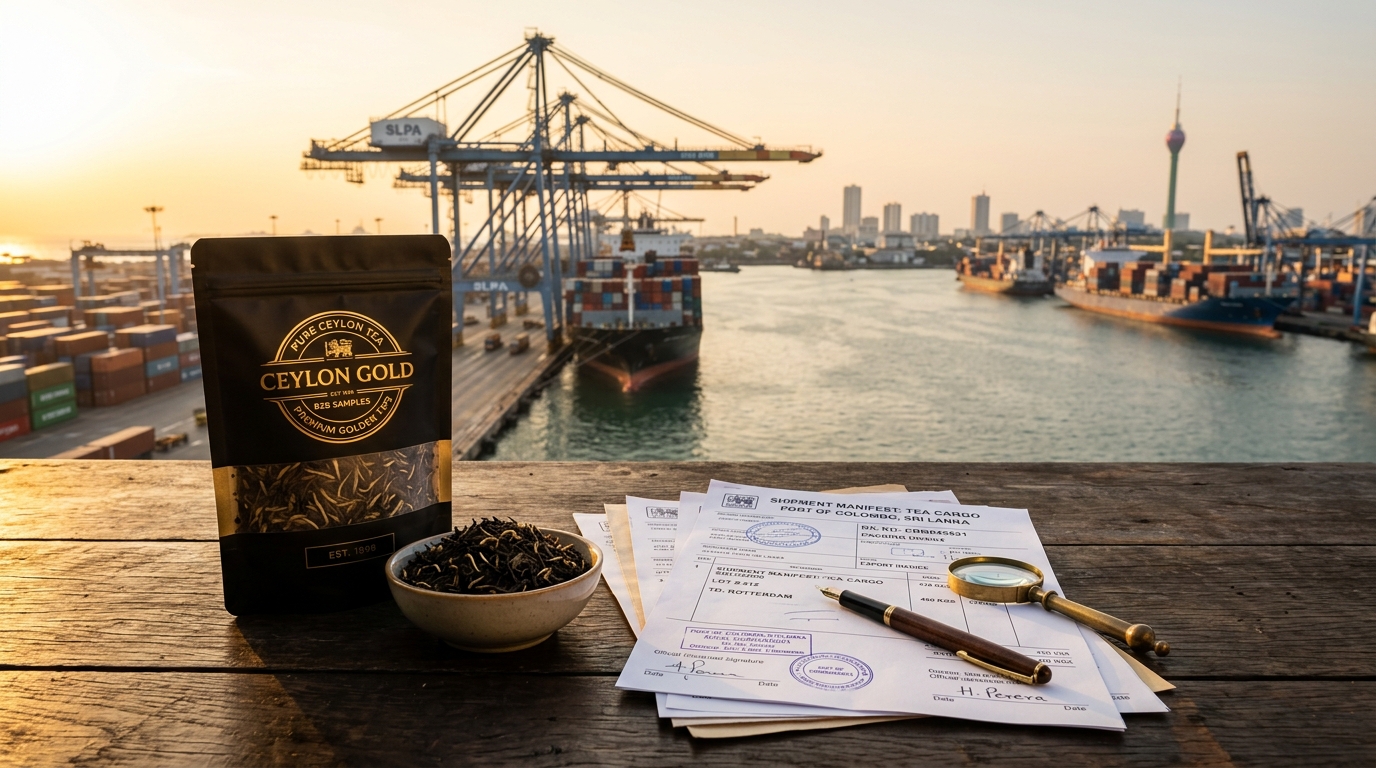
Under FOB Colombo, the seller is responsible for the tea until it is loaded onto the vessel at the Port of Colombo. Once the tea is on board, all risks and costs—including ocean freight, insurance, and destination port charges—shift to you, the importer.
- Why choose this: It gives you total control over the freight forwarder and the shipping line. You can negotiate your own freight rates and choose a carrier that offers the fastest transit times.
CIF (Cost, Insurance, and Freight)
In a CIF contract, the seller covers the cost of the tea, the insurance, and the freight to the destination port. The risk transfers to the buyer once the goods are on board in Colombo, but the seller pays for the transit.
- Why choose this: It is convenient for buyers who do not want to manage international freight logistics. However, you have less control over the shipping route and the insurance policy details.
CFR (Cost and Freight)
CFR is identical to CIF, but with one major difference: the seller does not provide insurance. The buyer is responsible for arranging their own marine insurance.
- Why choose this: This is ideal if you have a pre-existing annual insurance policy that offers better coverage or more competitive premiums than the seller could provide.
Trade Specification & Incoterms Comparison Table
| Parameter / Term | FOB (Free on Board) | CIF (Cost, Insurance, Freight) | Best Practice Recommendation |
|---|---|---|---|
| Freight Cost | Paid by Buyer | Paid by Seller | Use FOB for cost control |
| Insurance | Buyer's Responsibility | Seller's Responsibility | Buyer should always insure |
| Risk Transfer | Once on ship | Once on ship | Standard in trade |
| Control | High (Buyer selects line) | Low (Seller selects line) | FOB for volume importers |
4. Documentation, Certificates & Customs Compliance
Documentation is the heartbeat of international trade. A missing or incorrectly filled-out form can result in expensive port storage fees or, in worst-case scenarios, the seizure of your shipment by customs authorities.
- Bill of Lading: The legal contract between the shipper and the carrier. It serves as the receipt for the cargo.
- Commercial Invoice: Must detail the value of the goods, the Incoterm used, and the payment terms.
- Certificate of Origin: Confirms the tea was grown and processed in Sri Lanka, which is often required for preferential tariff treatment.
- Phytosanitary Certificate: Validates that the tea is free from pests and meets the health standards of the destination country.
- Laboratory Test Reports: Essential for proving compliance with maximum residue limits (MRLs) for chemicals.
5. Contract Negotiations, Price Discovery & Payment Terms
Negotiating a tea contract is a balance of price, quality, and trust. Price discovery should be based on the latest Colombo Auction prices, which provide the most accurate benchmark for the market.
Payment Methods
- Letters of Credit (L/C): A bank-backed guarantee that the seller will be paid once they present the required documents. This is the safest method for both parties in large transactions.
- Telegraphic Transfers (T/T): Common for established relationships. The buyer pays a percentage upfront and the remainder upon presentation of shipping documents.
- Escrow Services: Used occasionally to hold funds until the goods have passed inspection at the destination port.
Safe Sourcing & Export Checklist
- Step 1: Pre-Shipment Inspection: Secure sealed production lot samples before finalizing the order to ensure the quality matches your requirements.
- Step 2: Laboratory Test Verification: Ensure maximum chemical residue and microbiological limits pass import regulations before the container is sealed.
- Step 3: Climate-Sealed Packing: Specify inner moisture-barrier lining to survive maritime transit.
- Step 4: Tamper-Evident Container Seal: Confirm high-security ISO container seals and temperature logging to ensure the cargo remains untouched.
Frequently Asked Questions About International Trade
1. What is the main difference between FOB and CIF? FOB (Free on Board) means the buyer is responsible for freight and insurance costs once the tea is on the ship. CIF (Cost, Insurance, and Freight) requires the seller to cover these costs until the shipment reaches the destination port.
2. When should an importer choose CFR over CIF? An importer should choose CFR (Cost and Freight) if they prefer to source their own marine insurance policy, perhaps to secure better rates or more comprehensive coverage than the seller provides.
3. Why is 'FOB Colombo' specifically important for tea? FOB Colombo ensures the buyer has full control over the shipping line, transit time, and freight costs from the Port of Colombo, which is critical for maintaining the freshness of high-quality Ceylon tea.
4. Who is responsible for customs clearance at the destination? Under standard Incoterms like FOB, CIF, and CFR, the buyer is always responsible for import customs clearance, duties, and taxes in their own country.
5. What documents are essential for tea import compliance? Essential documents include the Bill of Lading, Commercial Invoice, Packing List, Certificate of Origin, and Phytosanitary Certificate to ensure the tea meets global food safety standards.
6. Can I change the shipping term after the contract is signed? Yes, but it requires a formal amendment to the contract and agreement from both the buyer and the seller. It is always better to define the Incoterm clearly before the contract is finalized.
7. How do I verify the quality of the tea before it leaves Sri Lanka? You should always request a pre-shipment sample from the exporter. This sample should be tested in an accredited laboratory to ensure it meets your specific quality parameters and import regulations.
Conclusion
Mastering the logistics of the tea trade is an ongoing process of refining your contracts and deepening your understanding of global shipping protocols. By choosing the right Incoterms—whether it is the control offered by FOB or the convenience of CIF—you place yourself in a position of strength. Remember, the quality of your Ceylon tea does not end at the factory gate; it continues through every mile of its journey to your customer.
As you build your sourcing strategy, prioritize transparency with your exporters and maintain rigorous standards for documentation and packing. For those ready to take the next step in their sourcing journey, explore our Exporters Directory to connect with verified partners who understand the complexities of international trade and the value of premium Ceylon tea.