Ceylon BOP vs FBOP Tea Grades: Understanding Leaf Sizes, Tips, and Taste
When you look at a tin of loose-leaf Ceylon Black Tea, you will likely see three or four capital letters stamped on the label. Codes like BOP and FBOP might sound like industrial part numbers, but they are actually part of a precise, traditional grading system. Two of the most popular grades from Sri Lanka are Broken Orange Pekoe (BOP) and Flowery Broken Orange Pekoe (FBOP).
A common misconception among tea drinkers is that "broken" leaves are low quality swept up off the factory floor, or that "Orange Pekoe" means the tea is flavored with oranges. Neither is true. "Orange" refers to historical Dutch royalty (the House of Orange-Nassau), and "Pekoe" comes from a Chinese word for leaf buds. "Broken" simply means the whole tea leaf was cut or fractured during rolling to brew faster and release a bolder flavor.
In this guide, we will break down the real differences between Ceylon BOP vs FBOP. You will learn how each grade is made, how they look in the cup, how much caffeine they hold, and which one fits your daily routine best.
1. Quick Head-to-Head Overview: The Key Differences at a Glance
Both BOP and FBOP belong to the broken leaf tea grades family in traditional orthodox tea manufacturing. However, they deliver very different tea-drinking experiences because of leaf size and tip content.
- BOP (Broken Orange Pekoe): Consists of small, neatly broken leaf particles without leaf buds (tips). Because the leaves are smaller, they steep quickly, giving you a deep red cup with a strong, brisk, and invigorating taste. It is the classic morning tea that takes milk and sugar wonderfully.
- FBOP (Flowery Broken Orange Pekoe): Features slightly larger broken leaves mixed with tender leaf buds known as "golden tips" or "flowery tips." These tips give the tea a softer, honeyed aroma, a smooth mouthfeel, and a gentler amber color. It is ideal for afternoon drinking without any milk.
Side-by-Side Comparison Table
| Comparison Feature | BOP (Broken Orange Pekoe) | FBOP (Flowery Broken Orange Pekoe) | The Winner & Why |
|---|---|---|---|
| Leaf Appearance | Small, uniform, dark broken leaves without tips | Larger broken leaves with visible golden or silver tips | FBOP for visual beauty and craft appeal |
| Infusion Speed | Fast (2 to 3 minutes) | Moderate (3 to 4 minutes) | BOP for quick morning preparation |
| Cup Color | Deep crimson red with bright reddish rim | Bright golden-amber with clear copper highlights | Tie (BOP for deep color; FBOP for golden clarity) |
| Flavor Profile | Strong, brisk, robust, and slightly malty | Smooth, floral, honeyed, with mild astringency | FBOP for nuanced flavor; BOP for rich strength |
| Caffeine Impact | Faster release; feels strong and punchy | Smooth, steady energy with higher L-theanine | BOP for a wake-up kick; FBOP for calm focus |
| Best Enjoyed With | Milk, lemon, honey, or plain | Plain, or with a splash of warm water / lemon slice | BOP wins for milk tea lovers |
Quick Decision Framework: Which One Is Right for You?
2. How Each Tea Is Made: Step-by-Step Processing Differences
To understand why BOP and FBOP taste so different, we have to look at how tea masters process green tea leaves inside Sri Lankan tea factories. Both grades start with the same plant species, Camellia sinensis, but the picking and sorting stages set them apart.
Step 1: Harvesting and Leaf Selection
For a standard BOP, pluckers collect the classic "two leaves and a bud" from healthy tea bushes. For FBOP, pluckers pay special attention to young, unopened leaf buds. These soft buds are covered in tiny white hairs. When processed and dried, these hairs turn a glittering golden or silver shade, forming the "flowery tips" that give FBOP its name.
Step 2: Withering and Orthodox Rolling
Once picked, the fresh leaves wither on long mesh beds for 12 to 18 hours to reduce moisture. Next comes the rolling stage, which breaks open the plant cells to start oxidation:
- For BOP: The leaves pass through traditional mechanical rollers that exert moderate pressure. This cuts the leaves into small, neat, even fragments.
- For FBOP: Rollers are adjusted to apply lighter pressure. Lighter rolling preserves the soft leaf buds intact while gently breaking the surrounding leaves into slightly larger pieces.
Manufacturing Separation Flowchart
1. Fresh Plucking
Tender shoots gathered from high-grown or low-grown tea estates
2. Controlled Withering
Leaves lose moisture over 14 hours to become soft and pliable
3. Precision Orthodox Rolling
Rolling machine breaks cell walls to release natural enzymes
4. Sieve Separation
Mechanical rotary sieves separate smaller leaf particles (BOP) from tip-rich portions (FBOP)
5. Complete Oxidation & Firing
Warm air oxidation locked in by hot-air drying to stabilize final flavor
Step 3: Mechanical Sifting and Sorting
After oxidation and drying, the black tea passes through a series of vibrating mechanical sieves fitted with mesh screens.
The smallest leaf particles fall through finer meshes to become Fannings and Dust grades. The small, clean broken pieces without tips are collected as BOP. The larger broken fragments containing intact golden tips are separated as FBOP. You can learn more about this process in our deep dive on official Sri Lankan tea grades.
3. Cup Showdown: Color, Aroma, and Flavor Compared Side by Side
When you brew BOP and FBOP side by side in white porcelain cups, the visual and sensory differences are immediately obvious.
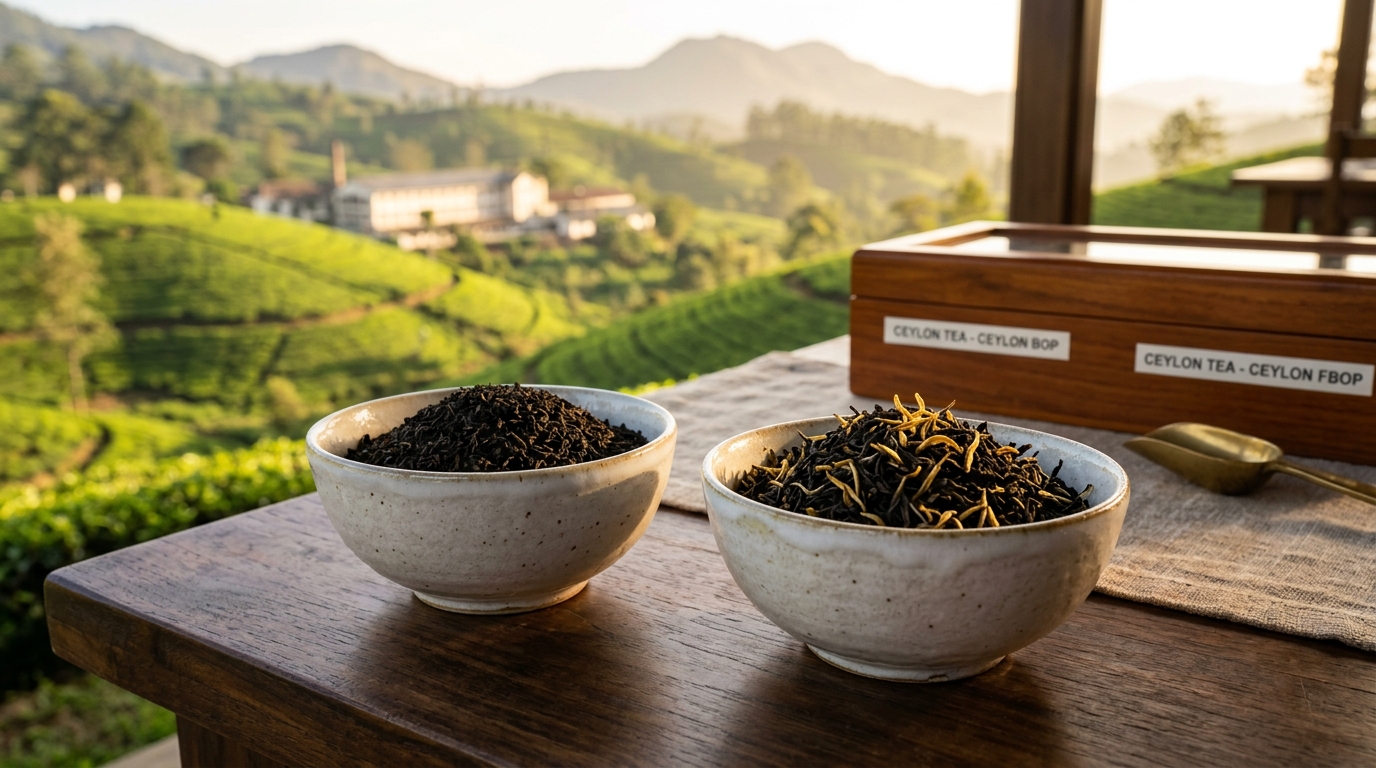
DRY LEAF VISUAL DIFFERENCE
Ceylon BOP ] [ Ceylon FBOP
Small particle size - Medium broken leaf size
Deep black / dark brown - Dark leaf + golden specks
Uniform, neat appearance - Visible velvety leaf tips
Dry Leaf and Wet Leaf (Infusion)
- BOP Dry Leaf: Uniform, dark, neat, and grainy. There are no golden specks. The wet leaf (called the "infused leaf") turns a uniform copper brown.
- FBOP Dry Leaf: Larger, twisted black leaves interspersed with distinct golden or silvery flecks. The infused leaf retains a bright, reddish-copper color with visible soft tip pieces.
Liquor Color and Clarity
- BOP: Yields a thick, dark ruby-red liquor within 2 minutes. It is dense and rich, showing a reddish ring along the inner rim of the teacup.
- FBOP: Yields a lighter, glowing amber-gold liquor. It has high clarity and brightness, reflecting light cleanly in the glass or cup.
Aroma and Flavor Notes
- BOP: Strong, direct, and energetic. In high-grown regions like Dimbula, BOP delivers crisp citrus notes, bright astringency, and a bold body. It quickly satisfies drinkers who want a sturdy cup of tea.
- FBOP: Softer, rounder, and aromatic. In low-grown regions like Ruhuna, FBOP exhibits caramel sweetness, subtle honey notes, and a floral aroma. The astringency is smooth rather than sharp.
| Sensory Parameter | BOP (Broken Orange Pekoe) | FBOP (Flowery Broken Orange Pekoe) |
|---|---|---|
| Aroma Intensity | Medium (Malty, citrus, toast) | High (Floral, sweet honey, delicate) |
| Body / Thickness | Heavy to medium-full | Medium to light-medium |
| Astringency / Crispness | High (Brisk, bright bite) | Low to medium (Smooth, rounded) |
| Finish / Aftertaste | Clean, brisk, slightly dry | Long, sweet, honeyed aftertaste |
4. Health Benefits, Antioxidants, and Caffeine Levels
Both BOP and FBOP come from 100% natural Camellia sinensis, meaning both are rich in plant antioxidants like polyphenols, theaflavins, and thearubigins. However, their health and caffeine profiles vary slightly due to leaf size and leaf age.
CAFFEINE RELEASE RATE COMPARISON:

BOP  : [████████████████████] High initial extraction speed (0-2 mins)
FBOP : [████████████░░░░░░░░] Moderate, sustained release rate (0-4 mins)
Caffeine Release Rates
- BOP: Because the leaves are broken into smaller particles, hot water extracts caffeine very rapidly. A cup of BOP gives you a quick, punchy morning lift.
- FBOP: The larger leaf size slows down extraction speed. Furthermore, young tips contain high levels of L-theanine, an amino acid that promotes calm focus. L-theanine softens the caffeine hit, providing steady, long-lasting mental energy without sudden jitters.
Antioxidant Profile
- Theaflavins (Brightness & Sparkle): Unopened leaf buds used in FBOP are packed with young catechins that turn into bright theaflavins during oxidation. This supports cardiovascular health and gives the tea its golden glow.
- Thearubigins (Depth & Strength): Mature leaves in BOP develop deeper thearubigins, which give the tea its rich dark color and support healthy gut digestion.
5. Best Ways to Brew, Serve, and Enjoy Each Tea
To get the absolute best flavor from your tea, you must adjust water temperature, steeping time, and leaf quantity for each grade. You can test different brew parameters with our interactive brewing timer and calculator.
How to Brew Ceylon BOP
BOP extracts quickly, so keep an eye on your timer to avoid over-steeping:
- Water Temperature: 95°C to 100°C (boiling water).
- Tea Amount: 2.5 grams (about 1 level teaspoon) per 220 ml of water.
- Steep Time: 2 to 3 minutes.
- Serving Suggestion: BOP is the ultimate breakfast tea. It pairs naturally with warm milk, a drop of honey, or a slice of fresh lemon. It stands up easily against heavy breakfast foods like bacon, eggs, toasts, or spiced pastries.
How to Brew Ceylon FBOP
FBOP needs slightly more room and time for its twisted leaves to unroll and release their fragrance:
- Water Temperature: 90°C to 95°C (just off the boil).
- Tea Amount: 3 grams (about 1 rounded teaspoon) per 220 ml of water.
- Steep Time: 3 to 4 minutes.
- Serving Suggestion: Enjoy FBOP plain in a clear glass or porcelain cup to appreciate its golden amber color and floral scent. If you prefer sweet tea, add a tiny bit of raw wildflower honey. It pairs beautifully with light afternoon treats like scones, shortbread, fresh fruit, or mild cheeses.
Recommended Brewing Protocol
6. The Final Verdict: Which One Should You Choose?
Choosing between Ceylon BOP and FBOP comes down to how you like to drink your tea and when you plan to drink it. Neither grade is "better" than the other; they are simply crafted for different moods and moments.
- Choose Ceylon BOP if:
- You want a strong, fast-brewing morning cup to jumpstart your day.
- You routinely add milk, cream, or sugar to your tea.
- You love a classic, brisk tea flavor with a bold finish.
- You are looking for an economical, high-value daily staple tea.
- Choose Ceylon FBOP if:
- You prefer drinking black tea straight without milk.
- You enjoy delicate floral scents, sweet honeyed notes, and smooth flavors.
- You want an elegant afternoon tea to share with guests.
- You appreciate the craft visual appeal of leaf tips in loose-leaf tea.
To ensure you are getting authentic single-origin Sri Lankan tea, always look for the official Pure Ceylon Tea Lion Logo on the package. This guarantees the tea was grown, harvested, and packed entirely in Sri Lanka under strict government quality standards.
Pure Ceylon Tea Lion Logo Certification
Frequently Asked Questions Comparing These Teas
1. Does "Broken" in BOP mean it is a low-quality tea grade?
No, not at all. In orthodox tea manufacturing, breaking the leaf is a intentional mechanical step designed to accelerate brewing and release robust flavors. High-grade BOP teas from high-elevation regions like Nuwara Eliya or Dimbula command top prices at the Colombo Tea Auction.
2. What do the golden tips in FBOP tea actually do?
Golden tips are young, unopened leaf buds that contain high concentrations of natural sugars, essential oils, and L-theanine. During brewing, they add sweetness, floral fragrance, and a smooth mouthfeel while reducing bitterness.
3. Can I add milk to FBOP tea?
You can, but it is generally recommended to enjoy FBOP straight. Because FBOP has subtle floral notes and a lighter body, heavy milk can overpower its delicate flavors. If you love tea with milk, BOP is the superior choice.
4. Which tea grade has more caffeine, BOP or FBOP?
Dry leaf tips in FBOP actually contain slightly more natural caffeine by dry weight than mature leaves. However, because BOP has smaller particle sizes, it extracts its caffeine into hot water much faster during a short 2-minute brew. Thus, a brewed cup of BOP often feels stronger and punchier.
5. Why is FBOP usually more expensive than BOP?
FBOP requires careful hand-plucking to gather delicate leaf buds without damaging them. It also requires gentler factory processing and meticulous sorting to keep the golden tips intact, which increases production costs.
6. Are BOP and FBOP teas suitable for making iced tea?
Yes! Both make fantastic iced teas. BOP creates a bold, traditional iced tea base that holds up well against ice cubes and lemon juice. FBOP makes a smooth, naturally sweet iced tea that requires little to no added sugar.
Conclusion
Whether you choose the bold strength of BOP or the elegant sweetness of FBOP, both tea grades showcase the rich heritage of Sri Lanka's tea industry. BOP delivers a satisfying daily cup that pairs effortlessly with breakfast, while FBOP offers a fragrant experience perfect for relaxing afternoons.
If you are a retailer, distributor, or passionate tea lover interested in discovering authentic Ceylon tea grades, explore our comprehensive Ceylon tea product catalogue or connect directly with verified suppliers through our B2B bulk tea exporter network.