
Smelling the Wet Leaves: What the Infused Leaf Bed Tells a Tea Master
The laboratory is quiet, save for the rhythmic clink of silver spoons against porcelain. Sunlight filters through the high windows, illuminating a row of white cupping bowls. Here, in the heart of the evaluation room, the steam rising from the vessels carries the history of a distant mountain garden. To the uninitiated, it is merely the smell of tea. To a master taster, it is a complex narrative written in volatile aromatics.
Smelling the wet leaves is not a casual act; it is a diagnostic procedure. When we decant the liquor and turn our attention to the bed of infused leaves left behind, we are peering into the soul of the manufacture. This is where the secrets of the traditional process are laid bare.
1. The Cupping Protocol: Equipment, Water & Ratios
Professional evaluation requires a controlled environment to ensure that the variables remain constant. Without standardization, you are not tasting the tea; you are tasting your own brewing errors.
A standard cupping set consists of a white porcelain bowl and a matching lid. The white surface is non-negotiable, as it provides the neutral background necessary to judge the color of the liquor and the vibrancy of the infused leaf. We use precision scales to measure exactly 5.6 grams of tea, ensuring the ratio remains consistent regardless of leaf density.
Water quality is the invisible variable. We use filtered, low-mineral water heated to 95°C. By keeping the ratio of water to leaf and the temperature of the pour identical across all samples, we ensure that any differences we detect are inherent to the tea itself—the terroir, the plucking standard, and the manufacturing skill.
2. Dry Leaf Evaluation: Appearance, Sizing & Craftsmanship
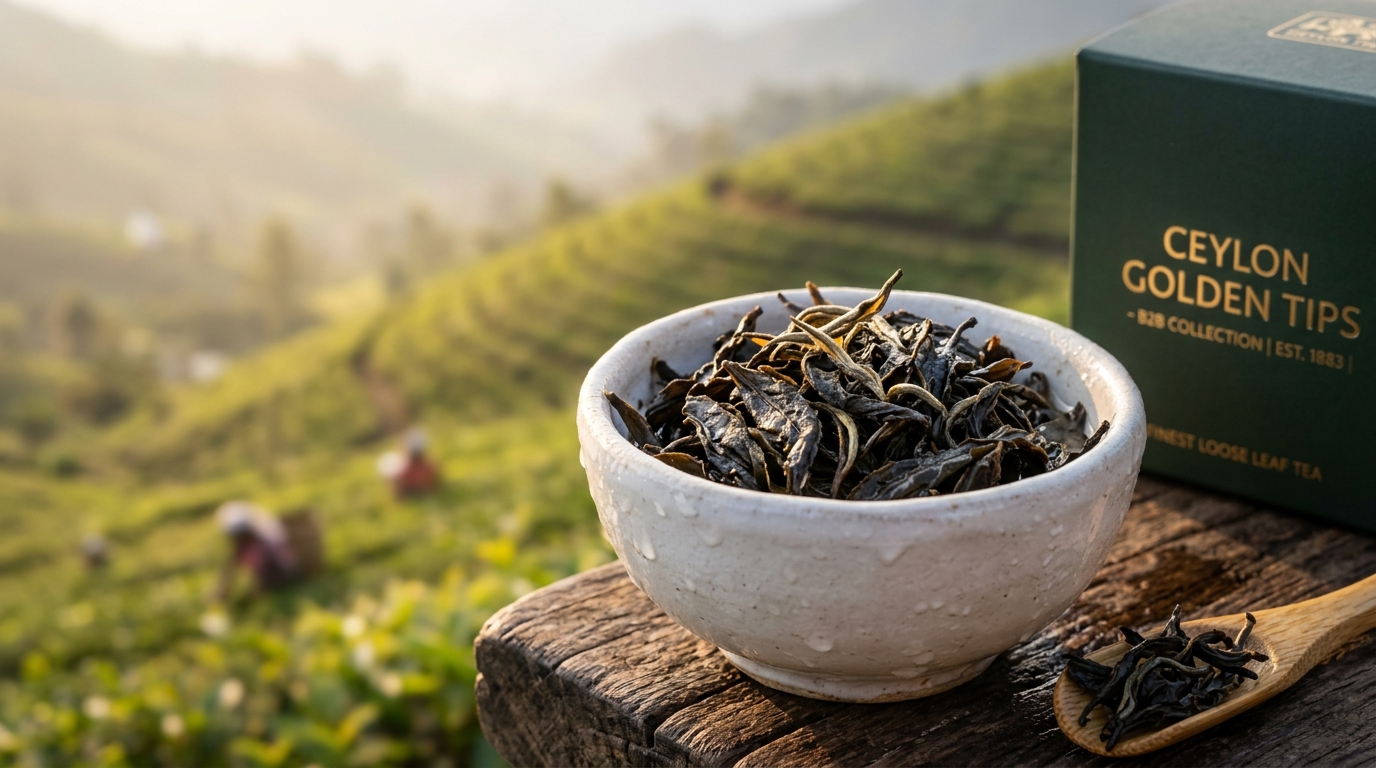
Before the water ever touches the leaf, we assess its dry state. This is the first chapter of our evaluation. We look for uniformity in the twist and the size of the leaf particles. Are the tips golden and intact? Does the leaf look "clean," or is it broken and dusty?
A well-crafted Ceylon black tea should display a consistent sizing, reflecting the grades defined by the Colombo auction standards. We look for a healthy, dark sheen, which often signals proper moisture content and careful handling during the rolling and drying stages. A dull, matte appearance may suggest an overly dry environment or, conversely, improper storage.
3. The Infusion Phase: Temperature, Steeping Time & Volatiles
The infusion phase is where the leaf surrenders its stored character. As the hot water hits the dry leaf, it releases a burst of volatile compounds. This is a fleeting moment; the first thirty seconds of infusion are often the most telling.
We cover the bowl with the lid to trap these aromatics. By holding the steam within the vessel, we create a concentrated environment. When we finally lift the lid, the aroma that greets us is the true signature of the botanical science involved. If the tea is from the high-altitude Nuwara Eliya region, we expect a bright, floral nose. If it is from the warm, lower-elevation Kandy gardens, the profile will likely be more robust and malty.
4. Wet Leaf Aroma & Color Inspection
Once the liquor is decanted, the "wet leaf bed" remains. This is our primary focus. We smell the leaves immediately, while they are still hot.
- Garden Freshness: A sweet, slightly grassy, or floral scent indicates a tea that was plucked at its peak and processed with care.
- Firing Accuracy: If the leaves smell of toasted grain or warm bread, the firing stage was executed perfectly. If the scent is sharp, acrid, or reminiscent of burnt wood, the tea was likely over-fired.
- Seasonal Winds: In certain Uva teas, you can detect a distinct "wintery" quality—a cooling, resinous aroma that speaks to the high-altitude winds during the quality season.
Color is equally vital. A vibrant, coppery-red leaf indicates an ideal level of oxidation. If the leaves appear greenish or mottled, the oxidation was likely uneven or interrupted. If the leaves are dark brown or nearly black, the tea may have been over-oxidized or subjected to excessive heat.
5. Palate Evaluation: Briskness, Body & Flavor Architecture
Now, we turn to the liquor. The "slurp" is perhaps the most distinctive sound in a tasting room. By aspirating the tea—essentially slurping it with a sharp intake of air—we atomize the liquid. This allows the tea to coat the entire palate and travel up to the lingering aftertaste olfactory system.
We look for the "body" of the tea: its weight and viscosity on the tongue. Is it thin and watery, or does it possess a rounded, syrupy quality? We also assess the "briskness," a characteristic astringency that is the hallmark of fine Ceylon tea. It should invigorate the mouth rather than dry it out harshly.
6. The Taster's Lexicon: Decoding Scoring Terminology
To communicate our findings, we use a shared language. These terms help us categorize the quality and character of the lot.
- Briskness: A lively, refreshing sensation on the tongue. It is the opposite of dull or flat.
- Coppery: The ideal, bright reddish-brown color of a well-oxidized black tea leaf.
- Pungent: A strong, assertive character that is often found in high-quality, high-grown teas.
- Body: The perceived weight or thickness of the tea liquor.
- Astringency: The drying sensation caused by tannins. A positive trait when balanced; a negative one when overwhelming.
Master Sensory Scorecard Table
| Grade / Lot Tier | Dry Leaf Appearance | Liquor Brightness | Body & Viscosity | Flavor Notes | Finish Duration |
|---|---|---|---|---|---|
| High-Grown BOP | Wiry, dark, golden tips | Brilliant copper | Medium, silky | Floral, citrus | Long, clean |
| Medium-Grown FBOP | Twisted, some tips | Bright amber | Full, round | Malty, honey | Medium |
| Standard CTC | Granular, uniform | Deep red | Heavy, thick | Bold, earthy | Short to medium |
| Low-Grown Pekoe | Large, curly leaf | Dark, intense | Very full, rich | Sweet, woody | Long |
Professional Sensory Cupping Protocol
Frequently Asked Questions About Professional Sensory Evaluation
Why do professionals smell the wet leaves after decanting? The infused leaf bed holds the concentrated aromatic profile that heat has released. It reveals firing accuracy, the presence of any off-notes, and the true character of the terroir.
What does a 'vegetal' smell in the wet leaves indicate? A vegetal aroma often suggests a shorter firing or a lighter oxidation level. In high-quality teas, this manifests as fresh-cut grass or spring greens; in lower grades, it may lean toward raw or grassy notes.
How can I tell if a tea was over-fired just by smelling the leaves? An over-fired leaf often emits a sharp, burnt, or carbonized aroma. Instead of the delicate floral or honeyed notes expected, you will detect a harsh, dry, or metallic scent.
Does the color of the wet leaf matter as much as the smell? Yes, color is a vital indicator of oxidation levels and leaf integrity. A uniform, coppery, or bright color suggests even processing, while mottled or dull leaves may indicate uneven fermentation.
Can beginners practice professional cupping at home? Absolutely. By using a consistent ratio of tea to water and a standardized timing, you can train your palate and nose to identify the subtle differences in tea quality.
Conclusion
The art of the tea master is rooted in observation. By focusing on the wet leaf bed, we step beyond the simple act of drinking and into the realm of evaluation. Every leaf tells a story of the soil it grew in, the hands that plucked it, and the factory that transformed it. As you continue to explore the diverse types of Ceylon tea, remember to pause and smell the leaves. You will find that the most profound insights are often hidden in the steam of a freshly infused bowl. For those looking to deepen their connection to the craft, consider exploring our resources on the Ceylon tea ceremony to further refine your appreciation.