
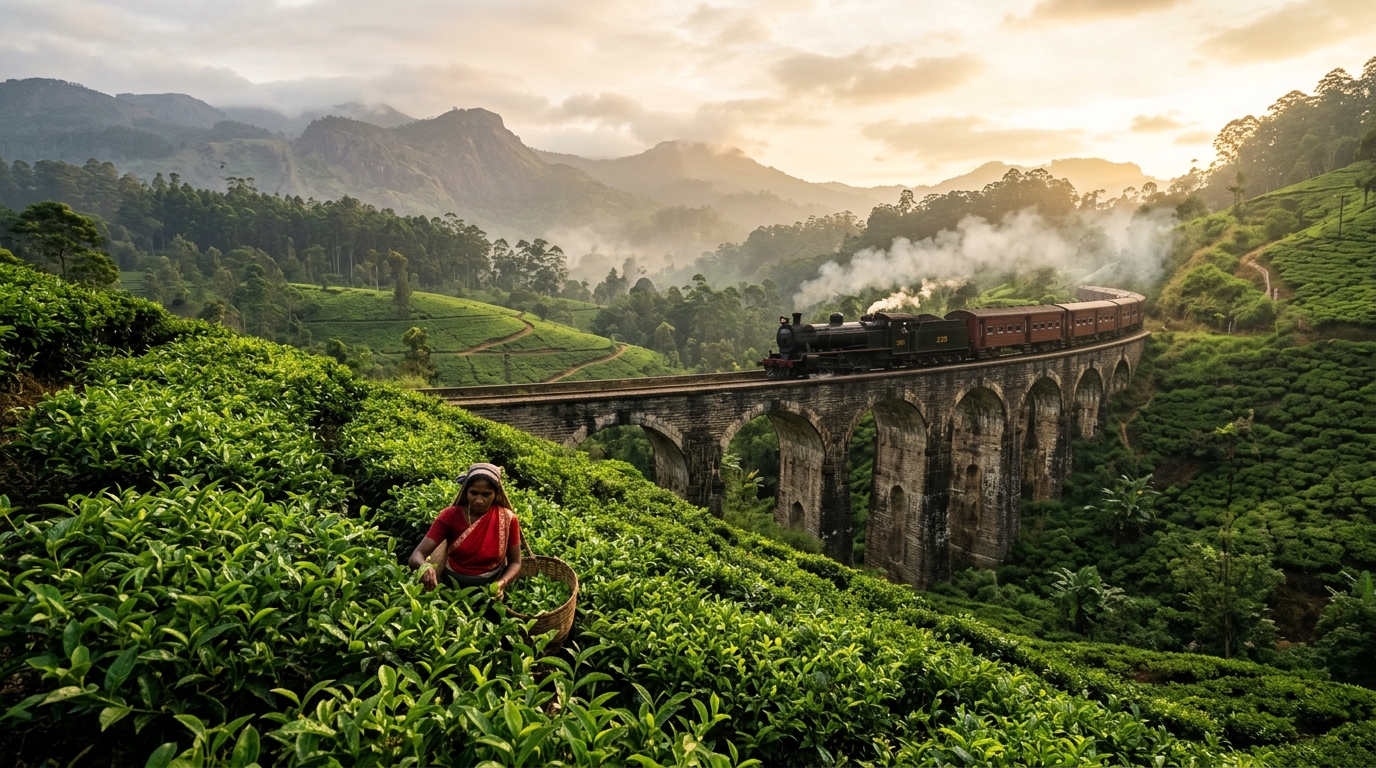
The Epic Tea Train: How Carving Railways Through the Clouds Saved Ceylon Tea
In the mid-1870s, the lush, mist-covered mountains of central Ceylon faced a quiet, devastating crisis. Following the collapse of the coffee industry due to a lethal fungus, planters were gambling their futures on a new, unproven leaf: tea. Yet, even as the first successful harvests emerged from the soil of the Dimbula and Nuwara Eliya highlands, a massive obstacle remained. The tea, once plucked and processed, had no efficient path to the sea. It sat in mountain warehouses, vulnerable to spoilage, while the only transport available—lumbering bullock carts—took weeks to navigate the treacherous, narrow mountain passes to the port of Colombo.
The survival of the entire industry depended on a radical solution: bringing the industrial revolution to the clouds. This is the story of the "Tea Train," a monumental feat of engineering that carved iron paths through the jagged peaks and dense jungles of the interior. By conquering the vertical landscape, these railways did more than just move cargo; they defined the very identity of Ceylon Tea.
The Crucible of Origins: The Crisis that Sparked Revolution
The transition from coffee to tea was not a smooth pivot; it was a desperate scramble for survival. When the coffee blight decimated plantations in the 1870s, the island’s economy teetered on the edge of ruin. Tea was the only viable alternative, but it required a completely different logistical approach. Unlike coffee, which is a dried, durable bean, tea is a delicate, moisture-sensitive product that demands speed from bush to shipping crate.
The existing infrastructure was entirely inadequate. Planters faced the reality that even if they grew the finest tea in the world, the lack of a reliable transport system meant it would lose its quality before reaching the international market. The colonial government realized that without a railway, the tea industry would remain a small-scale, local curiosity. The mandate was clear: the government had to connect the remote, high-altitude Uva and Central Provinces to the commercial hub of Colombo.
The Pioneers: Visionaries Who Built the Industry
The construction of the mountain railway was not merely a government project; it was a collaborative labor of persistence. British civil engineers, often working in isolation, were tasked with surveying routes that seemed impossible. They faced heavy monsoon rains, the constant threat of landslides, and the challenge of carving through solid rock without modern machinery.
Local planters also played a crucial role. They acted as unofficial logistics coordinators, lobbying for rail extensions and often providing the necessary land and local knowledge to navigate the dense, uncharted terrain. These individuals understood that the railway was their lifeline. They were not just farmers; they were pioneers of an industrial ecosystem, transforming the rugged mountain slopes into a structured, efficient, and interconnected tea production network.
Engineering Feats: Railways, Bridges & Mountain Infrastructure
The construction of the railway is often cited as one of the greatest engineering achievements of the 19th century. To ascend from the coastal plains to the high-altitude tea country, engineers had to design routes that climbed thousands of feet while navigating sharp, hairpin turns and deep valleys.
The Mastery of Stone and Brick
The most iconic symbol of this era is the Nine Arch Bridge, located near Ella. It was built entirely of stone, brick, and cement, with no steel reinforcement. This design choice was born of necessity during the First World War when steel was scarce. The bridge remains a structural marvel today, a testament to the durability of colonial-era engineering.
Carving Through the Mist
Tunnels were blasted through granite mountains to keep the train on a steady, manageable incline. These tunnels, such as the famous Summit Tunnel at Pattipola, allowed the train to cross the watershed of the island. This was the moment the "Tea Train" became a reality, enabling the rapid transport of high-grown, quality tea to the port of Colombo for international auction.
The Invention of Processing Machinery
As the railway brought the tea to the ports, the speed of production had to match the speed of transport. Initially, tea was processed in simple, wooden verandah factories using manual rolling techniques. However, as demand grew, the need for efficiency led to a wave of local mechanical innovation.
Planters and engineers began developing machines that could mimic the delicate hand-rolling process but on a massive scale. Innovative rollers, drying machines, and sorting sifters were installed in multi-story factories strategically located near the railheads. This integration of factory location and rail access meant that tea could be plucked, processed, and loaded onto a train within hours, capturing the peak freshness that would later become the hallmark of Ceylon Black Tea.
The Evolution of Public Auctions & International Trade
With the railway providing a reliable "conveyor belt" to the sea, the industry needed a standardized way to trade its output. This led to the establishment of the Colombo Auction system. Before the railway, trade was fragmented and inconsistent. The rail network allowed for the consolidation of tea grades from various estates, ensuring that buyers in London and beyond could rely on consistent quality.
The auction system became the heartbeat of the industry. It turned tea into a formal commodity, with clear standards for quality, origin, and processing. Because the railway ensured that tea from the remote hills arrived in Colombo in pristine condition, the auction prices reflected the true value of the leaf, cementing Ceylon’s reputation as a world-class producer.
Living History: Preserving Craftsmanship in the Modern Era
Today, many of the original stone factories still stand, functioning as they have for over a century. These are not merely museums; they are living, breathing facilities where multi-generational families continue the craft of tea production. They represent a bridge between the industrial innovation of the past and the sustainable, quality-focused tea industry of the future.
The railway itself remains a cherished part of the landscape. While it is now a major tourist attraction, it continues to serve as a reminder of how the "Epic Tea Train" saved an industry. It is a story of how a small island, through sheer grit and engineering genius, moved its most precious resource from the clouds to the cups of the world.
| Era / Year | Landmark Milestone | Key Person or Region | Why It Shaped the Modern Industry |
|---|---|---|---|
| 1870s | Coffee Blight Crisis | Central Highlands | Forced the shift to tea as the primary export crop. |
| 1885 | Main Line Extension | Nanu Oya Region | Connected the heart of tea country to Colombo for the first time. |
| 1910s | Nine Arch Bridge Construction | Uva Province | Proved that massive infrastructure could be built with local materials. |
| 1920s | Auction System Maturation | Colombo | Standardized trade and established global quality benchmarks. |
| Modern Era | Heritage Preservation | Island-wide | Blends tradition with sustainable, high-quality production methods. |
Historical Milestones of Industrial Innovation
1. The First Experimental Acres
Early pioneers cultivate experimental crops, proving viability in mountain soil
2. The Verandah Factory
Hand-rolling gives way to locally engineered wooden rolling tables
3. First International Shipments
First commercial trial shipments reach London, receiving acclaim for briskness and color
4. Founding of the Auction System
First public auctions convene, standardizing weekly international trade
5. Modern Certification Era
The industry establishes global benchmarks for purity, sustainability, and origin protection
Frequently Asked Questions About the History & Heritage
Why was the railway essential for the Ceylon tea industry? Without the railway, tea had to be transported by bullock carts over treacherous mountain paths. The train provided a reliable, high-capacity link to the port of Colombo, preventing spoilage and ensuring freshness.
What makes the Nine Arch Bridge a landmark of tea history? The Nine Arch Bridge is a masterpiece of colonial engineering built entirely of stone, brick, and cement without steel. It symbolizes the ingenuity used to connect isolated tea estates in the Uva region to the national rail network.
How did the railway change the geography of tea production? The rail network allowed for the expansion of tea cultivation into remote, high-altitude regions like Nuwara Eliya and Dimbula, which were previously too inaccessible for large-scale agricultural export.
Who were the primary figures behind the mountain railway? British civil engineers and local laborers worked together to carve tunnels and bridges through the dense jungle and steep cliffs, overcoming immense logistical challenges and tropical diseases.
Is the tea train still used for transport today? While modern road networks handle much of the logistics, the railway remains a vital cultural and logistical artery, preserving the historical legacy of the tea industry while serving as a world-renowned scenic route.
Conclusion
The story of the "Epic Tea Train" is more than a historical footnote; it is the fundamental narrative of how Ceylon Tea conquered the world. By carving through the clouds, the pioneers of the 19th century did more than transport a commodity—they created an infrastructure that allowed for the preservation of quality, the standardization of trade, and the flourishing of an entire culture.
As you enjoy your next cup of Ceylon tea, consider the journey that tea has taken from the high-altitude, mist-shrouded slopes to your home. It is a journey made possible by the vision of those who looked at a mountain range and saw not an obstacle, but a path. To continue your exploration of this remarkable legacy, we invite you to learn more about the traditional manufacturing process that defines the character of every leaf.